
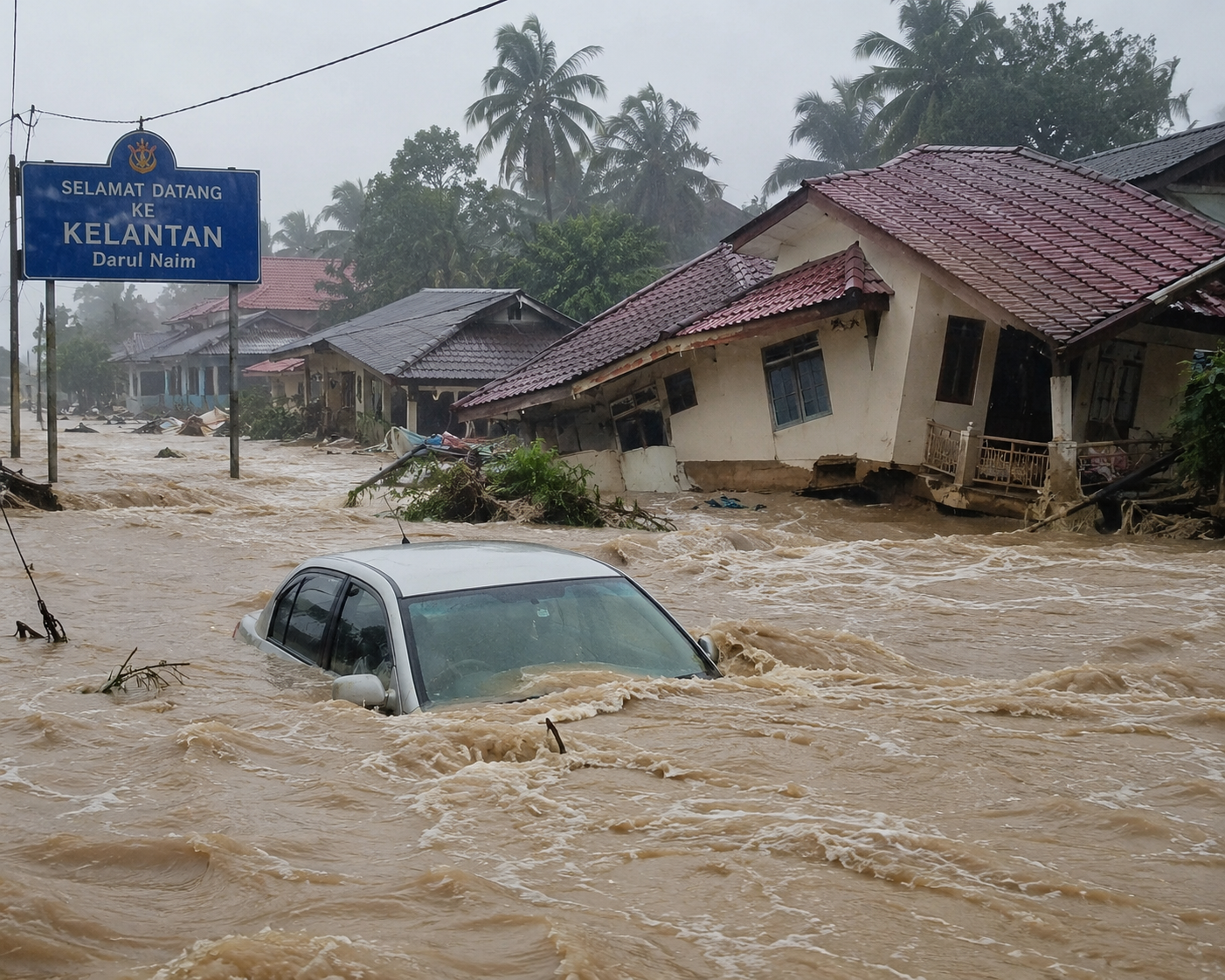
This is the real story of a flood victim who survived the Kedah floods in 2022 and told the story. How is climate change connected to flooding? What can you and I do about it? – Mr Anu’s story
Floods are destroying the homes of thousands of families in our country every year.
Mr Anu is a 45 year old man, living in Alor Setar with his wife and two teenage children. He works at the wet market and stays with his family on a landed property. His dilemma started when developers started building several housing projects in his neighbourhood, which affected the drainage and caused the area to be flood-prone.
In 2022, during the rainy season, there was continuous rain for a whole day which caused heavy flooding and the waters rose quickly. Mr Anu, his family and neighbours were stranded; and the Civil Defence team had to rescue them with boats and transport them to safety in a community hall.
Mr Anu described it as the most anxious moment of his life as he was worried about the safety of his family. He was grateful for the support from his neighbours, who were also going through the same harrowing experience.
After two days, when the flood waters had receded he was allowed to return to his house but was dismayed to find all his furniture, electrical appliances and other belongings destroyed by the flood waters; and the house thickly covered with mud and sludge. He was grateful for friends who helped him and his family to clean the house; and a local church community supplied them with food rations. He and his family have returned to their normal lives since then and hope that they will never experience such a traumatic event again.
Floods can also be caused by climate change, where the Earth’s temperature becomes increasingly warmer. Human activity such as deforestation, building and construction, and the burning of fossil fuels, releases heat-trapping greenhouses gases or carbon emissions into our atmosphere.
According to data gathered by the United Nations, Malaysia’s average surface temperature increased between 0.14 to 0.25 degrees Celsius per decade from 1970 to 2013. Malaysia’s average temperature has been on an upward trajectory since 1964, when it was 24.93°C. By 2020, the average temperature was 26.05°C, about a degree warmer.
Typically, one would expect droughts in the face of rising temperatures. While heat waves and droughts are among the effects of climate change, a rise in temperature also causes more rainfall in localized areas. This is because warmer temperature causes more water to evaporate from the land and oceans and changes the rainfall patterns. It is estimated that the atmosphere holds seven percent more moisture for every 1°C rise. As more moisture is held by the atmosphere, subsequent rainfall is more intense, leading to flooding. Changes in temperature also affect monsoon weather systems, which controls the distribution of rainfall. This means rainfall is less predictable and may come in large bouts, causing floods in one area and withheld in longer periods elsewhere, causing drought.
Modeling by the Meteorological Department shows that Malaysia could experience a temperature rise of 0.7°C to 2.6°C in the next few decades. This could lead to changes in rainfall of 30 percent less in some months and 30 percent more in other periods of the year. According to a report by the Asian Development Bank, modeling using various greenhouse gas concentration scenarios shows an increase in populations exposed to floods in the future. Under the RCP8.5 scenario, an additional 70,000 people would be affected by floods in Malaysia in 2030, with damages rising by RM8.58 billion. RCP8.5 refers to a scenario where carbon emissions continue to rise without intervention, in other words, the worst- case climate change scenario.
As God’s people, we have a duty to protect the Earth by stopping climate change through reducing our carbon emissions.
“…God saw all that he had made, and it was very good.” – Genesis 1:31

